
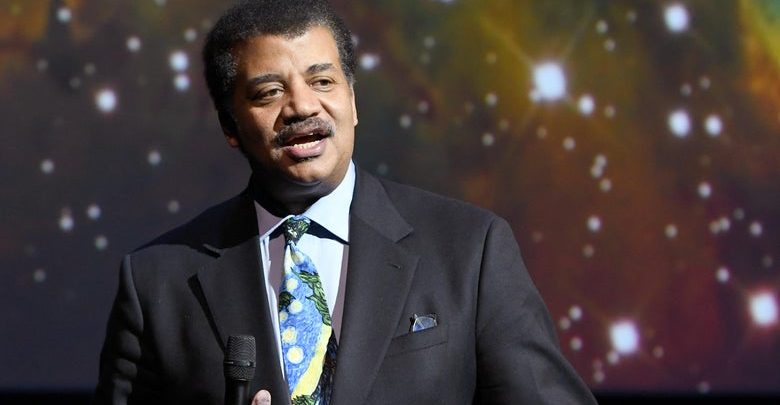
Neil deGrasse Tyson is an American astrophysicist born on October 5, 1958 in New York. Since 1996, he has been director of the Hayden Planetarium at the American Museum of Natural History in New York. He is one of the most popular American scientists, often considered Carl Sagan’s heir. Since 2006, he presents the NOVA scienceNOW program on PBS.
The asteroid (13123) Tyson is named in his honor.
Tyson was born in New York, the second of three children. His father, Cyril deGrasse Tyson, was a sociologist and human resources director for the city under Mayor John Lindsay. His mother, Sunchita Feliciano Tyson, was a gerontologist. He studied at the Bronx High School of Science from 1973 to 1976 where he was captain of the wrestling team and editor of the School’s Physical Science Journal. Tyson has a very early interest in astronomy and studies it steadily during his adolescence. He becomes a famous prodigy in the astronomical community and gives lectures on the subject at the age of 15. Tyson said his interest in astronomy began when he climbed to the top floor of his apartment in a New York City building (known as “Skyview Apartments”) to look at the moon with binoculars.
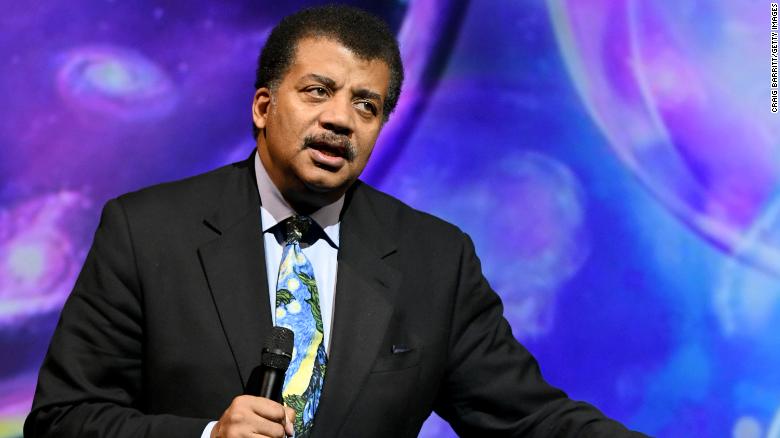
Astronomer Carl Sagan, who was a member of Cornell University, tried to recruit Tyson as a student but Tyson chose Harvard where he specialized in physics. He is a member of the rowing team in his first year, but resumes the wrestling thereafter, becoming a letterman (distinction for success) in his last year. Tyson earned a BA in Physics at Harvard in 1980 and began his postgraduate studies at the University of Texas at Austin where he earned an MA in Astronomy in 1983. In addition to wrestling and rowing, he is also a dancer in different genres such as jazz, ballet, and Latin and Afro-Caribbean dances. In 1985, he won the gold medal with the University of Texas Dance Team at a national championship in the style of Latin International Ballroom Dance. He began his Ph.D. program at the University of Texas but moved to Columbia University in 1988, where he earned a Ph.D. in Astrophysics in 1991.
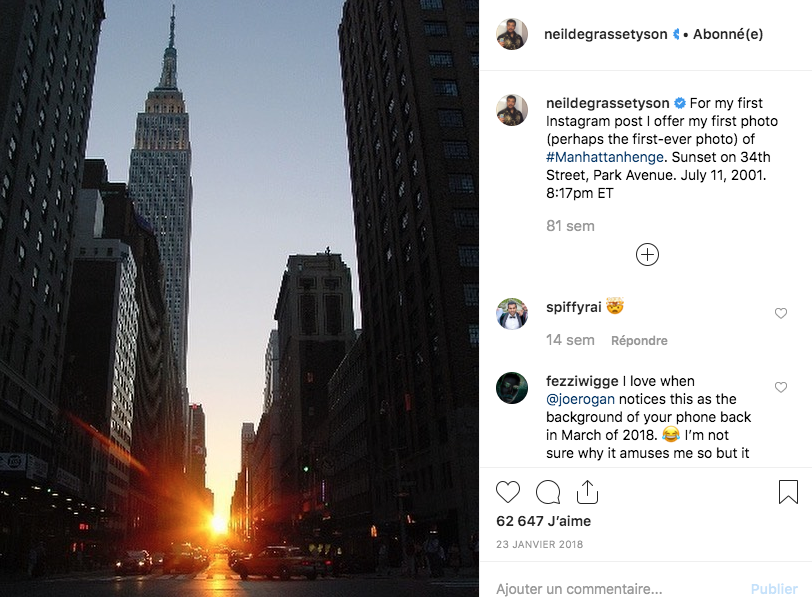
Tyson has written a large number of books on astronomy. In 1995, he began writing articles in the review Natural History under the section called “The Universe”. In a post in this 2002 review, he invented the term “Manhattanhenge” (derived from Manhattan and Stonehenge) to describe the two annual days when the sun is lined up with the high streets of Manhattan, as the sunset is visible along the streets.
In 2004, he took part in Origins on the PBS channel in the Nova science series and co-authored with Donald Goldsmith (California’s renowned astronomer and writer/science teacher) the book accompanying theOrigins: Fourteen Billion Years of Cosmic Evolution.
In 2001, US President George W. Bush appointed Tyson to the Commission on the Future of the US Aerospace Industry, and in 2004, Tyson was appointed to the President’s Commission on Policy Implementation. He is then rewarded by NASA’s Distinguished Public Service Medal, the highest civilian award given by NASA.
As director of the Hayden Planetarium in New York, Tyson decided to change Pluto’s traditional planet-to-planetarium classification, preferring groupings by similarities: small inner planets, gaseous giants, distant minor bodies. He stated in The Colbert Report that as a result of this decision, he received a large number of letters of dissatisfaction, most of them coming from children. In 2006, the International Astronomical Union requalified Pluto as a dwarf planet.
Tyson served as vice president, chairman, and director of The Planetary Society. He is the current presenter of the NOVA scienceNOW program on PBS.
He participates in the Beyond Belief Symposium in November 2006. In 2007, Tyson, known for his colorful character, cheerful temperament and obvious respect for the vast expanse of the universe, is chosen to be a recurring guest in the new series of The History Channel, The Universe, which becomes a popular success. In 2009, he began presenting the radio show Star Talk, with actress Lynne Koplitz.


